
God’s Appointed Feasts – Passover, Unleavened Bread, Firstfruits
The Feasts all speak of, and point to Jesus. Leviticus 23:2-4 “Speak to the children of Israel, and say to them: ‘The Feasts of the LORD, which you shall proclaim to be holy convocations, these are My Feasts. ‘Six days shall work be done, but the seventh day is a Sabbath of solemn rest, a holy convocation. You shall do no work on it; it is the Sabbath of the LORD in all your dwellings. ‘These are the Feasts of the LORD, holy convocations which you shall proclaim at their appointed times.”
God never rescinded His Feasts. During the first few hundred years after Jesus’ resurrection and ascension, the early Roman church tried to erase all Jewishness from Christianity, including these God ordained Feasts.
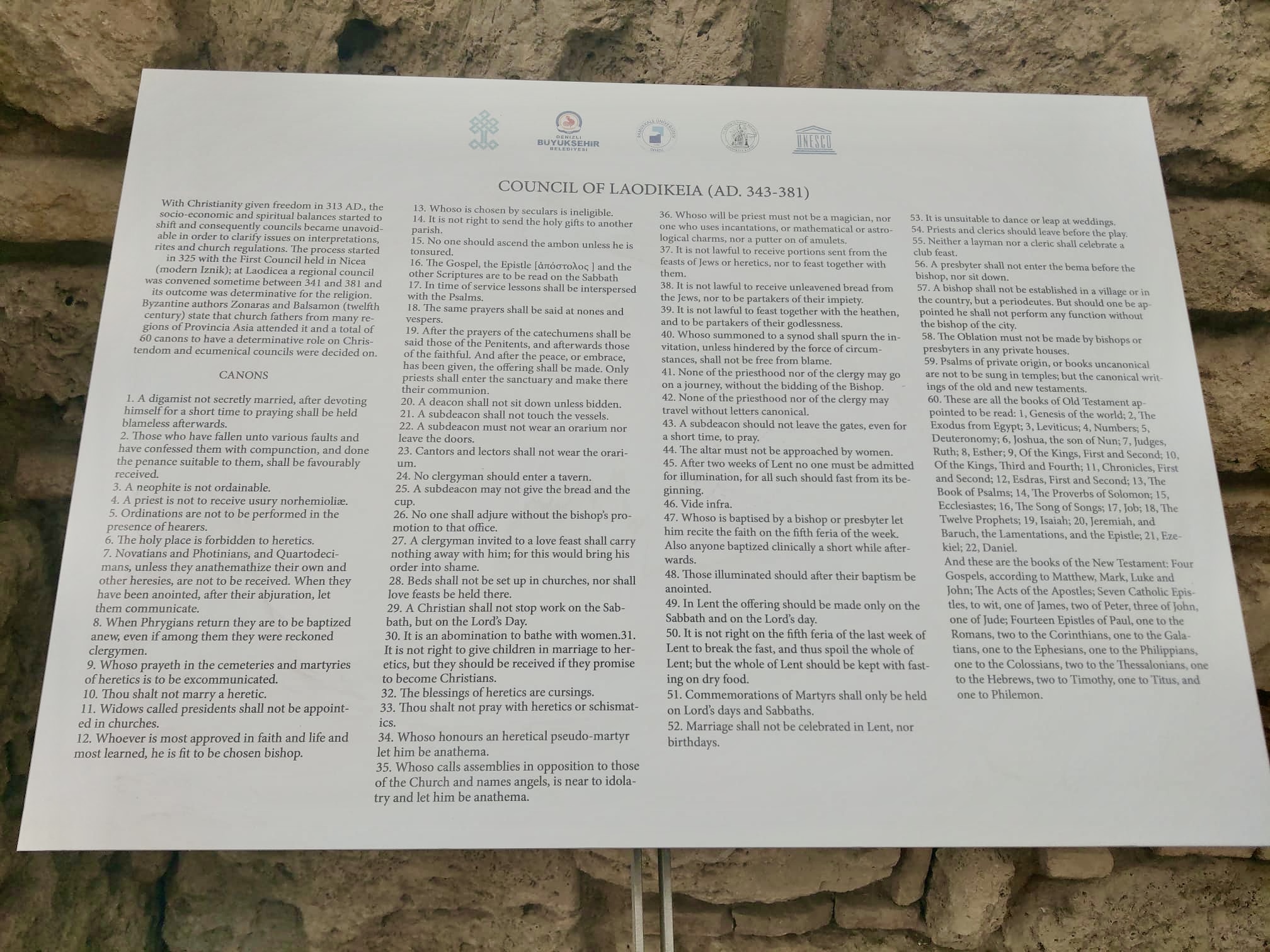
This is a plaque in Turkey, where the Council of Laodicea (343-381 AD), declared the following canons into church law:
7. Quartodecimans (fourteeners, i.e. those who celebrate Passover on the 14th of the first Jewish month), must renounce and declare accursed their own and other heresies.
29. A Christian shall not stop work on the Sabbath, but on the Lord’s Day.
37. It is not lawful to receive portions sent from the feasts of Jews or heretics, nor to feast together with them.
38. It is not lawful receive unleavened bread from the Jews, nor to be partakers of their impiety.
The Feasts of God:
1. Passover. (Lev. 23:5)
2. Unleavened bread (Lev. 23:6)
3. Firstfruits. (Lev. 23:10-11)
4. Counting 50 days to the Feast of Weeks (Shavuot or Pentecost). (Lev. 23:15-17)
5. Trumpets (Lev. 23:24)
6. Atonement (Lev. 23:27-28)
7. Tabernacles (Lev. 23:34)
The apostles kept the Feasts of God, see Acts 18:20-21 “When they asked him to stay a longer time with them, he did not consent, but took leave of them, saying, ‘I must by all means keep this coming feast in Jerusalem; but I will return again to you, God willing.’ And he sailed from Ephesus.
The Feast of Passover
The Feasts of Passover, Unleavened Bread, and Firstfruits usually overlap.
Lev.23:4-5 “These are the Feasts of the LORD, holy convocations, which you shall proclaim at their appointed times. On the fourteenth day of the first month at twilight is the LORD’s Passover.”
In 2026 the 14th of the first month on the Jewish calendar (named Aviv or Nisan) falls on Wednesday 1st April.
Scriptures on Passover instituted:
Exodus 12:2-3, 6-8, 11, 13-14. NKJV
”This month shall be your beginning of months; it shall be the first month of the year to you. Speak to all the congregation of Israel, saying: ‘On the 10th of this month every man shall take for himself a lamb, according to the house of his father, a lamb for a household. Now you shall keep it until the 14th day of the same month. Then the whole assembly of the congregation of Israel shall kill it at twilight. And they shall take some of the blood and put it on the two doorposts and on the lintel of the houses where they eat it. Then they shall eat the flesh on that night; roasted in fire, with unleavened bread and with bitter herbs they shall eat it. And thus you shall eat it: with a belt on your waist, your sandals on your feet, and your staff in your hand. So you shall eat it in haste. It is the LORD’s Passover. Now the blood shall be a sign for you on the houses where you are. And when I see the blood, I will pass over you; and the plague shall not be on you to destroy you when I strike the land of Egypt. ‘So this day shall be to you a memorial; and you shall keep it as a feast by an everlasting ordinance.'”
Exodus 6:6-7 “Therefore say to the children of Israel; ‘I am the LORD; I will bring you out from under the burdens of the Egyptians, I will rescue you from their bondage, and I will redeem you with an outstretched arm and with great judgments. I will take you as My people, and I will be your God who brings you out from under the burdens of the Egyptians.”
Why do we celebrate Passover? Ephesians 1:5-7 NKJV says: “…having predestined us to adoption as sons by Jesus Christ to Himself, according to the good pleasure of His will, to the praise of the glory of His grace, by which He made us accepted in the Beloved. In Him we have redemption through His blood, the forgiveness of sins, according to the riches of His grace.”
Colossians 2:14-15 NKJV “…having wiped out the handwriting of requirements that was against us, which was contrary to us. And He has taken it out of the way, having nailed it to the cross. Having disarmed principalities and powers, He made a public spectacle of them, triumphing over them in it.”
How do we celebrate Passover? As we are grafted into Israel according to Romans 11, we remember Israel’s rescue, deliverance, and redemption from Egypt (Exodus 6:6-7). We celebrate our own rescue, deliverance and redemption from the bondage and slavery of sin, having been adopted as God’s people (Eph.1:5-7). We can share a meal, including unleavened bread and wine and bitter herbs, and read from the Bible, however God leads, for example about Israel’s exodus from Egypt, and about Jesus’ Passover meal with His disciples, also Gethsemane, His arrest, crucifixion and resurrection, and about the New Covenant:
Jeremiah 31:33 NKJV “But this is the covenant that I will make with the house of Israel after those days, says the LORD; I will put My law in their minds, and write it on their hearts; and I will be their God, and they shall be My people.”
Hebrews 10:16-17 “’This is the covenant that I will make with them after those days, says the LORD; I will put My laws into their hearts, and in their minds I will write them,'” then He adds, “Their sins and their lawless deeds I will remember no more.”
Scriptures on Jesus’ Passover meal with His disciples: Luke 22:13-15, 17, 19-20 NKJV “So they went and found it just as He had said to them, and they prepared the Passover. When the hour had come, He sat down, and the twelve apostles with Him. Then He said to them, ‘With fervent desire I have desired to eat this Passover with you before I suffer;’ Then He took the cup, and gave thanks, and said, ‘Take this and divide it among yourselves;’ and He took bread, gave thanks and broke it and gave it to them, saying, ‘This is My body which is given for you; do this in remembrance of Me.’ Likewise He also took the cup after supper, saying, ‘This cup is the new Covenant in My blood, which is shed for you.'”
The Feast of Unleavened Bread
Lev.23:6-8 ESV “And on the 15th day of the same month is the Feast of Unleavened Bread to the LORD; for seven days you shall eat unleavened bread. On the first day you shall have a holy convocation; you shall not do any ordinary work. On the seventh day is a holy convocation; you shall not do any ordinary work.” Leaven is a symbol of sin: It grows and spreads unseen, until all is permeated. Avoiding all leaven, and eating unleavened bread, (for example Matza) for 7 days, we examine ourselves before God to identify any sin and ask for God’s cleansing with the blood of Jesus.
1. Cor. 5:7-8 NKJV “Therefore purge out the old leaven, that you may be a new lump, since you truly are unleavened. For indeed Christ, our Passover, was sacrificed for us. Therefore let us keep the Feast, not with old leaven, nor with the leaven of malice and wickedness, but with the unleavened bread of sincerity and truth.”
Firstfruits
The Firstfruits was the first and best of the harvest, and it represented the whole of the harvest. If God accepted the Firstfruits, He would also accept the rest of the harvest.
Lev. 23:10-11,14 NKJV “Speak to the children of Israel, and say to them: ‘When you come into the land which I give to you, and reap its harvest, then you shall bring a sheaf (omer) of the first fruits of your harvest to the priest. He shall wave the sheaf before the LORD, to be accepted on your behalf; on the day after the Sabbath the priest shall wave it. You shall eat neither bread nor parched grain nor fresh grain until the same day that you have brought an offering to your God; it shall be a stature forever throughout your generations in all your dwellings.'”
There are different understandings about when the waving of the sheaf of barley Firstfruits was. As it says ‘the day after the Sabbath’, it is possibly always on the first day of the week. After being in the grave for three days and three nights, Jesus was resurrected on the first day of the week. Matt. 12:40 NKJV says: “For as Jonah was three days and three nights in the belly of the great fish, so will the Son of Man be three days and three nights in the heart of the earth.”
Matt.28:1-2 NKJV “Now after the Sabbath, as the first day of the week began to dawn, Mary Magdalene and the other Mary came to see the tomb. And behold, there was a great earthquake; for an angel of the LORD descended from heaven, and came and rolled back the stone from the door, and sat on it.”
1. Cor.15:20,23 NKJV “But now Christ is risen from the dead, and has become the Firstfruits of those who have fallen asleep. But each one in his own order.; Christ the Firstfruits, afterwards those who are Christ’s at His coming.”
After the waving of the Firstfruits sheaf (omer) of barley, they counted 50 days towards the Feast of Weeks, also called Shavuot, or Pentecost (when Moses received The Ten Commandments from God).
Lev. 23:15-16. NKJV “And you shall count for yourselves from the day after the Sabbath, from the day that you brought the sheaf of the wave offering: seven Sabbaths shall be completed. Count 50 days to the day after the seventh Shabbat; then you shall offer a new grain offering to the LORD.”
This is probably when the wheat harvest was ready for a Firstfruits sheaf to be picked. These are 50 days of examining ourselves before God, to identify sins, even in our thoughts, heart attitudes, intentions and motivations, turning back to God for cleansing by the blood of Jesus. We are reminded how dependent we are on our Most High God for everything. Jesus Christ died for us at Passover, paid the price for all our sins, and delivered us from the slavery of sin. We are now also remembering and counting the days to the outpouring of the Holy Spirit after 50 days, on Pentecost. This was 10 days after Jesus’ ascension, on the 40th day of counting.
by Enone Smit